In today’s context, characterized by increasing attention to sustainability and infrastructure safety, reducing leaks in gas distribution networks has become a priority for operators. Uncontrolled leakages impact both operational and environmental efficiency, as well as management costs, in a scenario where the energy transition requires more resilient and digitalized networks. Technological innovation therefore plays a key enabling role in supporting infrastructure evolution and ensuring higher service standards.
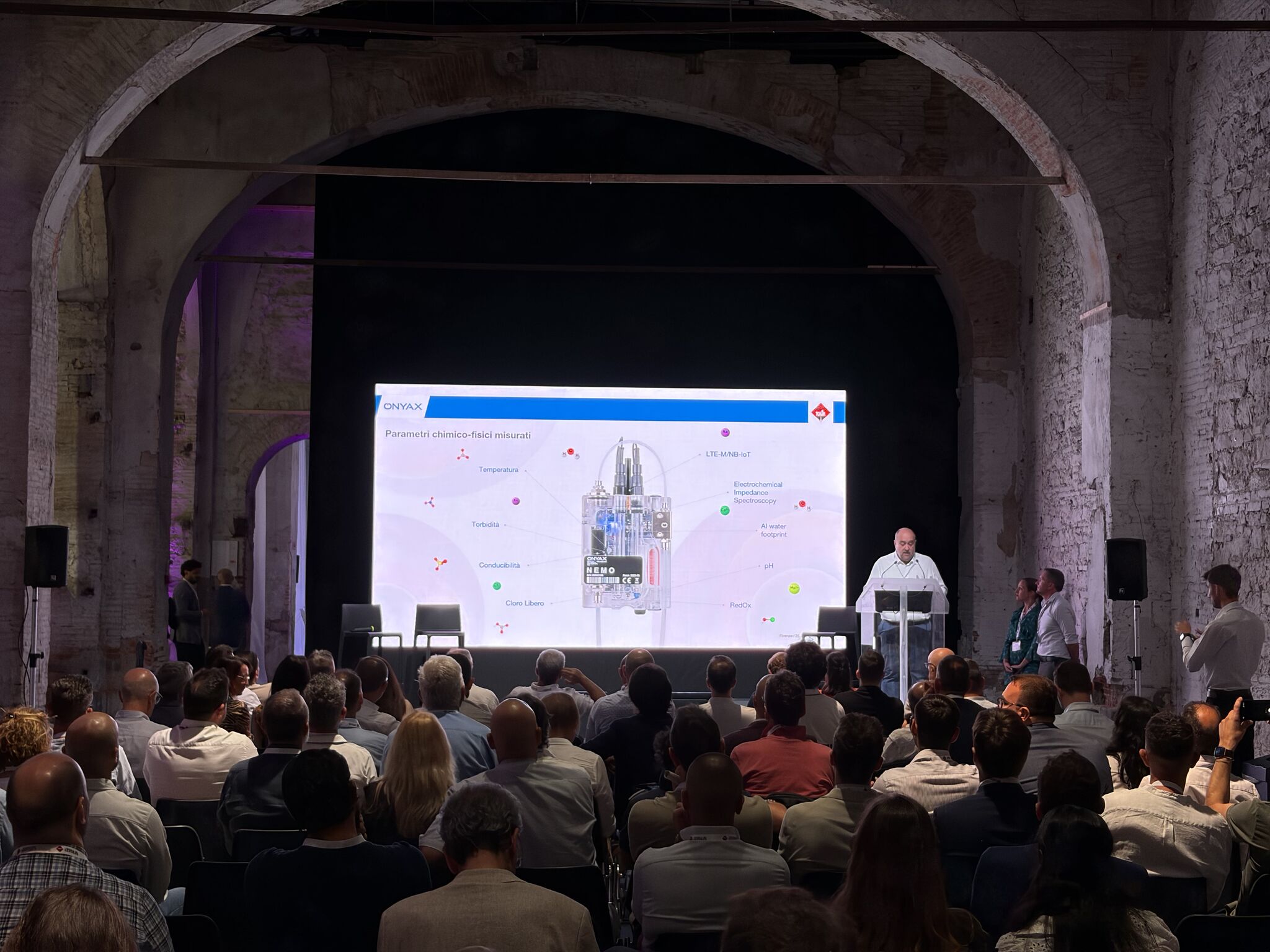
Within this context operates Onyax, an Italian SME specialized in electronic design and the development of IoT solutions and Artificial Intelligence platforms for network monitoring and control. The company adopts a “turnkey solutions” approach that integrates hardware device design, software development, and intelligent data management.
A distinctive element is the adoption of an AI on Edge paradigm: part of the processing is performed directly on IoT devices installed in the field, enabling an initial local analysis of signals and greater overall efficiency in communication with the proprietary ACE platform, where information is further correlated and analyzed.
The solution
Due to their size and widespread distribution, gas distribution networks present complex challenges in terms of continuous remote monitoring and timely anomaly detection. Regulatory evolution, combined with decarbonization targets and investments aimed at digitalizing strategic infrastructures, requires operators to adopt reliable and scalable technological tools capable of integrating into existing operational processes.
EVALD (Electro-Vibro-Acoustic Leakage Detect), a project developed by Onyax in collaboration with the Politecnico di Milano, introduces an innovative leak detection approach based on electro-vibro-acoustic analysis of signals generated by the network. Through distributed sensors and advanced machine learning and deep learning algorithms, the system is designed to recognize recurring patterns, detect weak signals associated with micro-leaks, and distinguish actual anomalies from background noise, thereby reducing false positives. Initially developed for the gas sector, the technological model also demonstrates strong transferability to the water sector, where acoustic signal propagation characteristics are particularly favorable.
The system architecture is based on the integration of sensors, dataloggers, and an AI analysis platform. The TUBE-EVA device operates as a sensor installed at the measurement point and enables the detection of pressure, temperature, vibrations, and acoustic signals through an integrated microphone; for a more effective active approach, it is also used with an integrated speaker. The collected data are transmitted to the main datalogger, BLACKBOX-XL-EVA, which manages data collection, local pre-processing according to AI on Edge logic, and communication with the central platform. Data transmission is carried out through 4G and LTE/Cat-M technologies, low-power communication standards designed for distributed IoT applications, ensuring broad coverage and reliability. Both devices are equipped with a Modbus interface, a widely used industrial protocol for data exchange between electronic systems.
The collected data are then integrated into Onyax’s ACE platform (Acquisition, Control, Ecosystem), or into third-party systems, where they are aggregated and analyzed using algorithms for event correlation and the generation of dashboards and operational reports. In this way, raw data are transformed into high-value information, supporting operators in identifying critical issues.
Below is a representative image of leak visualization within the ACE platform:

The application case
Field validation of the project is currently underway in collaboration with A2A RetiPiù, a company of the Group active in natural gas and electricity distribution in Lombardy.
The pilot project involves the gas network in the territories of Seveso and Cesano Maderno, covering approximately 230 km of network through the installation of 180 measurement points, distributed as follows:
- 50 low-pressure listening points;
- 17 feeders;
- 38 GRF units (Final Reduction Groups);
- 75 cathodic protection potential measurement points.
The initiative falls within the framework of ARERA regulation, particularly Resolution 404/2022/R/gas, which governs monitoring, quality, and safety obligations for gas distribution services, encouraging the adoption of innovative tools to reduce leakages.
The devices are currently installed, and continuous testing activities are underway to validate performance. The project also includes a training phase for the Artificial Intelligence model, supported by the Music and Acoustic Engineering Department of the Politecnico di Milano, including annual seasonality analysis.
The objective is to demonstrate the scalability and reliability of the system in a real-world context, contributing to leak reduction. This is an evolving project whose future developments will be the subject of further analysis.
Conclusions
The EVALD pilot project represents a concrete step toward the digitalization of gas networks.
Expected benefits:
- Reduction of CH4 emissions and optimization of interventions;
- Improved network safety;
- Concrete contribution to sustainability.
Onyax positions itself as a technological partner for utility operators, providing integrated expertise and intelligent solutions focused on sustainability. A growing project designed to support infrastructure evolution toward more digital and sustainable models.